


Published on July 13, 2026 / By Iñaki Urdanibia
“Talking about freedom only makes sense if it means having the freedom to tell people what they don’t want to hear.”
Eric Arthur Blair, known by the pen name George Orwell (Motihari, India, 1903 – London, 1950), was a man who ruffled everyone’s feathers—and I mean across the entire political and ideological spectrum—who fought and wrote guided by a quest for justice, brotherhood, decency, truth, human dignity, always ready to demonstrate unwavering fidelity to the stark and brutal reality, throwing unpleasant truths at the world, like someone splashing a bucket of cold water right in the face; an exemplary parrhesiast. He is best known for his works Animal Farm and 1984, from which certain terms have gained widespread recognition and popularity: Big Brother, Newspeak, Doublespeak, Doublethink, and his own name used as an adjective to describe dystopian situations, referred to as Orwellian.
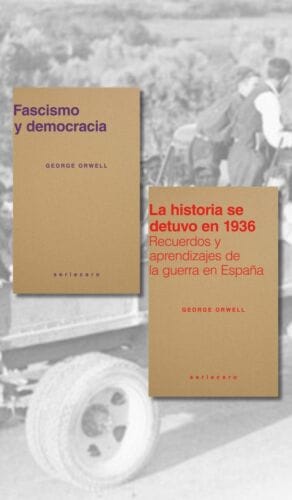
Today, the Spanish publisher Bauplan is releasing two volumes in its “Seriecero” collection by the author of Homage to Catalonia. History Stopped in 1936. Memories and Lessons from the Spanish Civil War and Fascism and Democracy.
The first of these, which takes its title from a phrase Orwell is said to have told Arthur Koestler, brings together five essays: “The Author’s Preface to the Ukrainian Edition of Animal Farm” (1947), “The Truth About the Spanish Civil War” (1937), “Why I Joined the ILP” (1938), “Notes on the Spanish Militias” (1937), and “Looking Back on the Spanish Civil War” (1942/1943).
In an Autobiographical Note dated April 17, 1940, we can read: “I got married in the summer of 1936. At the end of that same year, I went to Spain to fight in the Civil War, and my wife joined me shortly thereafter. I fought for four months on the Aragon front in the ranks of the POUM militias and was seriously wounded….” Eventually, after being hospitalized, he was forced to flee because an arrest warrant had been issued against him; it is certain that his experience on the front lines and during a leave of absence—during which he witnessed the events of May 1937 in Barcelona—led to a shift in his political outlook and his view of socialism, a shift he underwent in several stages. Regarding his escape, it is worth noting that those pursuing him were the very same people who labeled the POUMists as Trotskyist-Francoists or by other similar terms—a fact that is truly significant in light of Orwell’s turnaround, marked by disillusionment, Orwell’s shift following his wartime experience, as it provided him with insights and lessons about the left, the conflicts and manipulations within it, and war itself—all of which strengthened him in his struggle for freedom.
While in one of his writings he clearly states his position: “The fundamental truth of the war is quite simple: the Spanish bourgeoisie saw an opportunity to crush the labor movement and seized it, with the help of the Nazis and reactionary forces around the world,”, he attributes responsibility for the defeat in the war to the imbalance in military equipment between the two sides and to disunity among those defending the Republic under attack, emphasizing—on this last point—the major responsibility of Stalinism, which transposed the internal struggles within the land of the Soviets onto the Spanish conflict.
The collected texts paint a picture of the various aspects of the experience “south of the Pyrenees,” some written almost in the heat of the moment, others with the hindsight that time provides. One of the main lessons—if not the most important—was the widespread use of lies, both regarding the course of the conflict—as we saw in cases where great victories were proclaimed when in reality they were nothing but defeats—and through the concealment of certain clashes, with the media remaining silent about certain battles in which the author himself had taken part. Similarly, figures who were anything but heroic were turned into heroes, and dignified, principled individuals were branded as traitors, all to please or reassure believers or supporters. All these behaviors reveal the immense power of language when it comes to leading people in lockstep, encouraging herd mentality, and guiding them where it suits those in power; Orwell emphasizes that the use of certain language is a weapon that kills freedom just as surely as bullets do. He would explore all of this in the dystopian novels mentioned above. And the writer expresses, in the first person, his deep concern upon observing that “the very concept of objective truth is disappearing from the world,” and extends his concern to history, which is written using specific sources, meaning that the narrative serves interests that have nothing to do with the reality of the facts but with ideological interests, with the aim of encouraging or discouraging, and he does not fail to provide examples drawn not only from current events but also from the past, particularly regarding historical narratives, such as those related to slavery.
Some reflections emerge regarding the working class, emphasizing that, in the face of Franco, it was the most obvious enemy of the future caudillo, and stressing that if the working class had ultimately been defeated—for example, in the case of the Russian Revolution— it was due to a lack of international solidarity, not to mention the usurpation of power by a totalitarian party—which, to a large extent, was also occurring in the case of the ongoing war, given the non-intervention of neighboring countries; the intellectuals do not come across well: after shouting their slogans, they eventually succumbed to discouragement, at least for the most part. He pays tribute to the dignity and decency of a significant number of fighters, plagued by hunger and a lack of tobacco… and recounts scenes he witnessed at the hospital in Lérida, as well as the maneuvers of the secret police to get rid of troublesome individuals… many of whom were part of the International Brigades fighting against fascism, who represented “the flower and cream of the European working class, hunted down by the police of every country—those individuals who filled the mass graves of the Spanish battlefields and who now rot by the millions in forced-labor camps”… This retrospective concludes with a few verses he wrote when the war was clearly lost.
The second book, with its explicit title, brings together seven texts: the first of these, Fascism and Democracy, is the one that gives the volume its title, followed by: A Critique of Adolf Hitler’s Mein Kampf—Wells, Hitler, and the World State—Literature and Totalitarianism – Writers and the Leviathan – Freedom of the Park (Freedom in Hyde Park) and What Is Fascism? These texts were written in the 1940s, almost all of them during World War II.
The author does not hesitate to highlight certain virtues of liberal democracies, in that, when discussing politics with friends, one does not have the Gestapo or the GPU eavesdropping at the door; as for the second essay, he shows how communist parties in every country have become propagandists for the policies of the USSR, going so far as to justify the unjustifiable: the purges and show trials carried out in a bloody manner. As for the writer H.G. Wells and his works, he presents a negative view of them due to the somewhat naïve and biased perspective of this British author, who depicted a world that had already nearly disappeared—that of the nineteenth century—without taking into account the technological and scientific advances on the horizon; certainly, in the face of any hint of romanticism, he offered a resolutely scientific perspective, but one that was outdated.
He speaks out in defense of rebellion and freedom of expression, and dismantles certain criticisms aimed at limiting these tendencies and rights, or at silencing critics—sometimes under the fallacious pretext: “that is giving weapons to the enemy”; there is no doubt that Orwell took an unambiguous stand on the principle that “truth is truth, whether spoken by Agamemnon or his swineherd”. At the same time, he exposes the true nature of the totalitarian state, which instills a fear of thinking—or at least of thinking in fear—not to mention expressing one’s thoughts. In the case of the rise of Nazism and other authoritarian movements, he criticizes the utter blindness of the left, which is incapable of recognizing the danger.
He allows himself a few digressions on how prose is viewed, in the totalitarian worldview, as a more formidable enemy than poetry—though I’m not so sure… since one might ask Osip Mandelstam, Boris Pasternak, Marina Tsvetaeva, Anna Akhmatova, Vladimir Mayakovsky… He extols writers’ freedom to write without following the directives of any commissar, and emphasizes how every -ism carries the stench of propaganda; distinguishing, in writers’ work, between the citizen and the writer… which recalls the Kantian distinction between the public and private use of reason. He urges us not to fear taking on the role of a heretic and asserts the right—and the duty—to contradict oneself; and in the event that this might lead to serious problems, the wisest course would be to remain silent.
He denounces the police policy toward Hyde Park speakers, driven by a public opinion that, when not demanding a heavy-handed approach, applies a double standard—not forgetting that this park is an exception amid growing restrictions on freedom… while noting, nevertheless, that in liberal countries, not everything is rosy when it comes to freedom.
In conclusion, after distinguishing between different types of fascists (hyperbolic, overt, and invisible) and presenting examples of the misuse of the term “fascist”—which causes the word to lose its true meaning— he recommends that “all we can do for now is to use this word with a certain degree of caution and not, as is often done, reduce it to the level of an insult .” It is an ongoing struggle to give value to words and arguments in the face of the simplifications offered by grandiloquent slogans, which conceal nothing but an absolute void.
Source : https://kaosenlared.net/george-orwell-el-coraje-de-la-verdad/