


Towards a social ecology of techniques
Communotechny refers to the ability of human communities to design, manufacture, and use techniques for the common good. It is not simply a portmanteau word, but an attempt to restore meaning to technique as an intrinsically political and collective dimension of social life.
It refers to a central idea: technology is not neutral. It shapes the way we produce, live, perceive, and cooperate. Communotechny therefore questions the possibility of reorienting and reinventing know-how, tools, and modes of organization toward democratic, convivial, and emancipatory forms.
In this respect, it is part of the social ecology project: understanding that ecological crises are not primarily technical failures, but symptoms of a social and political relationship based on domination—of society over nature, but also of some humans over others. All of these are exacerbated a hundredfold by political economy and its intrinsic modus operandi: the relentless pursuit of value enhancement. Communotechny therefore sets itself the goal of contributing to collective emancipation by reconciling production, autonomy, and democracy.
A praxis of the commons
Communotechny cannot be reduced to a field of study or a simple critique of modern technology. It refers first and foremost to a praxis—a set of collective practices through which communities organize themselves to rebuild control over the technical means of their existence.
This praxis takes on meaning in shared workshops for “doing things together,” cooperatives, mutual aid networks, and popular assemblies: places where a collective intelligence is invented, rooted in the territory and concerned with social justice and political autonomy.
Communotechny, understood in this way, links action and reflection. It engages in a process of ongoing deliberation on ends and means: why do we produce? For whom? With whom? And how?
A critique of heteronomous technology
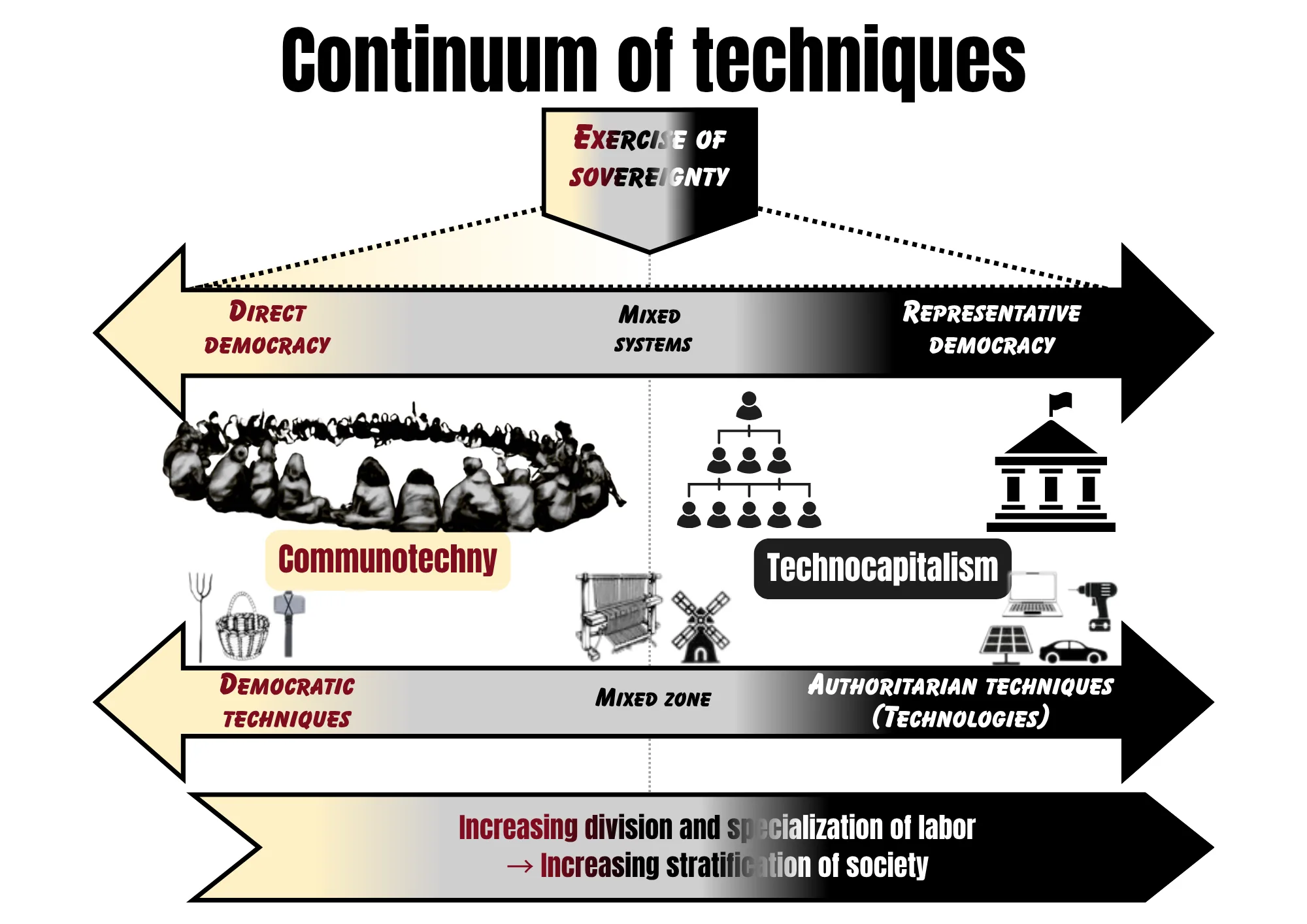
Faced with the growing dominance of centralized, automated, and extractive technological systems, communotechny offers a critique of what Lewis Mumford called “authoritarian techniques.” .” These techniques require hierarchical organization, extreme division of labor, concentration of power, and dependence on massive infrastructure. They embody a heteronomous model, where individuals become cogs in a productive apparatus over which they no longer have control.
Conversely, “democratic techniques”—based on cooperation, participation, and local control of the means of production—allow technical activity to be reintegrated into the living fabric of communities. They enable the collective reconstruction of knowledge and tools and nurture forms of political autonomy.
Communotechny sits within this tension: it does not condemn technique per se, but seeks to understand how each technical form conditions a form of society. It invites us to discern, in organizational and production choices, the seeds of domination or emancipation that they contain.
An ethical and political horizon
Communotechny opens up an ethical and political horizon that questions the way societies produce and reproduce their conditions of existence. It aims not only to transform technologies, but also to rethink the relationships between human beings and nature, between work and autonomy, between needs and desires.
It invites us to ask a series of questions: does a given technology increase the freedom of those who use it? Does it promote the autonomy of the communities that develop it? Does it allow for collective and democratic management of resources? Does it contribute to strengthening solidarity, justice, and cooperation?
From this perspective, communotechny is an extension of the critique of all forms of domination—economic, political, cultural, but also patriarchal. These forms of domination are rooted in hierarchical social structures, of which modern, centralized, and commercial technology is often both a product and a vector.
By relying on practices of cooperation, mutualization, and sharing, communotechny tends toward a society of care, technical gift-giving, and the commons. A society where reproductive, supportive, and caring activities—whether feeding, educating, caring for, or preserving ecosystems—are no longer relegated to the margins but become the very center of social organization.
The society of care and the commons is not a society of dependence, but of shared responsibility. It is based on the recognition of the interdependence of living beings—on an ethic of complementarity and equality among unequals—and on the need to preserve the conditions for sustainable communal life. It implies a reassessment of productive values and criteria of wealth, placing collective well-being well above any economic efficiency.
Communotechny as a political intention
Communotechny is not a fixed program or model. It is defined as a political intention: that of reorienting technical production towards forms of organization based on direct democracy, cooperation, and ecological responsibility.
It does not seek to oppose nature and culture, but to overcome their artificial separation. Recognizing that all techniques involve a certain relationship with the world, it invites us to make technical creation a space for political deliberation.
Thus, communotechny calls for a transformation of our imaginations: designing, repairing, transmitting, and sharing become political gestures. Rebuilding society requires the collective reconstruction of the power to produce and decide.
Far from rejecting the technique, it redefines its meaning. It seeks to turn instruments of dependence into tools of emancipation: no longer technologies in the service of growth, but techniques in the service of the common good.
[…] 🛠️ Communotechny […]
[…] 🛠️ Communotechny — Towards a social ecology of techniques […]
[…] 🛠️ Communotechny — Towards a social ecology of techniques […]
[…] 🛠️ Communotechny — Towards a social ecology of techniques […]