




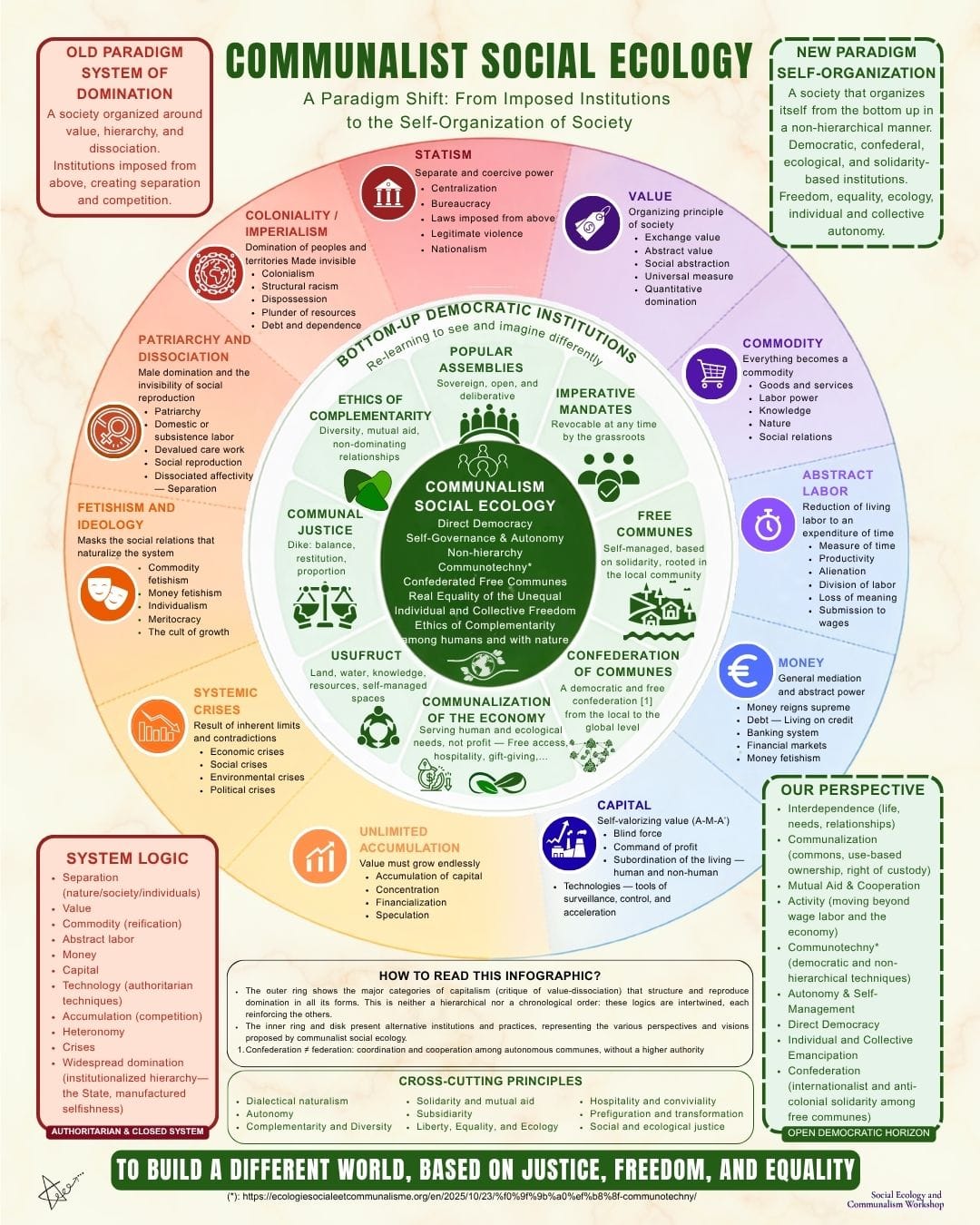

Communalist Social Ecology: From Imposed Institutions to the Self-Institutioning of Society
Today we are launching a new format for sharing information: the infographic. This first visual aid aims to provide a concise introduction to the Atelier’s theoretical and political project—communalist social ecology—conceived as a paradigm shift from the heteronomy of institutions imposed from above toward the democratic self-institution of society by society itself.
What the infographic shows
The diagram is organized into concentric circles. The outer ring lists the major logics of domination that structure and reproduce the current system—statism, coloniality, patriarchy, value, commodities, abstract labor, money, capital, unlimited accumulation, systemic crises, fetishism—and two lateral chains illustrate their logical derivation, from the initial separation between nature and society to generalized forms of domination.
Themiddle ring and the central circle present, in a mirror-like arrangement, the institutions and practices that communalist social ecology advocates to rebuild society on new foundations: popular assemblies, binding mandates, confederated free communes, commons of use, communalization of the economy, direct democracy, non-hierarchy, and an ethic of complementarity. A second chain, symmetrical to the first, outlines what this open democratic horizon might look like—from interdependence to individual and collective emancipation.
The cross-cutting principles that run through the whole—autonomy, solidarity and mutual aid, ecology, prefiguration, conviviality—remind us that these logics are neither sequential nor hierarchically ordered in relation to one another: they intertwine and reinforce one another, just like the alternatives that correspond to them.
The acknowledged limitations of such a medium
An infographic, by its very nature, synthesizes—it does not prove. Each category condensed here into a few keywords responds to complex theoretical debates, precise conceptual genealogies (Bookchin, Castoriadis, the critique of value, decolonial thought, theories of the commons…), and vocabulary choices that we have discussed at length among ourselves. The visual format, constrained by space and the need for immediate readability, cannot expand upon them, nuance them, or do justice to the disagreements and internal tensions that also run through our own collective thinking.
This infographic is therefore not intended to settle an issue or serve as a theoretical exposition: it is a starting point, an invitation to curiosity rather than a comprehensive summary. Some oversimplifications are unavoidable—a single category where several texts would be necessary, a keyword where a nuanced distinction should be made (such as the difference between a confederation and a federation, clarified in a footnote, but which alone would require a dedicated article).
Related Links:
and, of course, many other articles to discover on the Workshop.
Download this infographic here in English and in the desired resolution at 1080 x 1350 px:
- as a .jpeg (355 KB): ESC Infographic.jpeg
- as a .png (1 MB): ESC Infographic.png
- as a .pdf (2 MB): ESC Infographic.pdf