


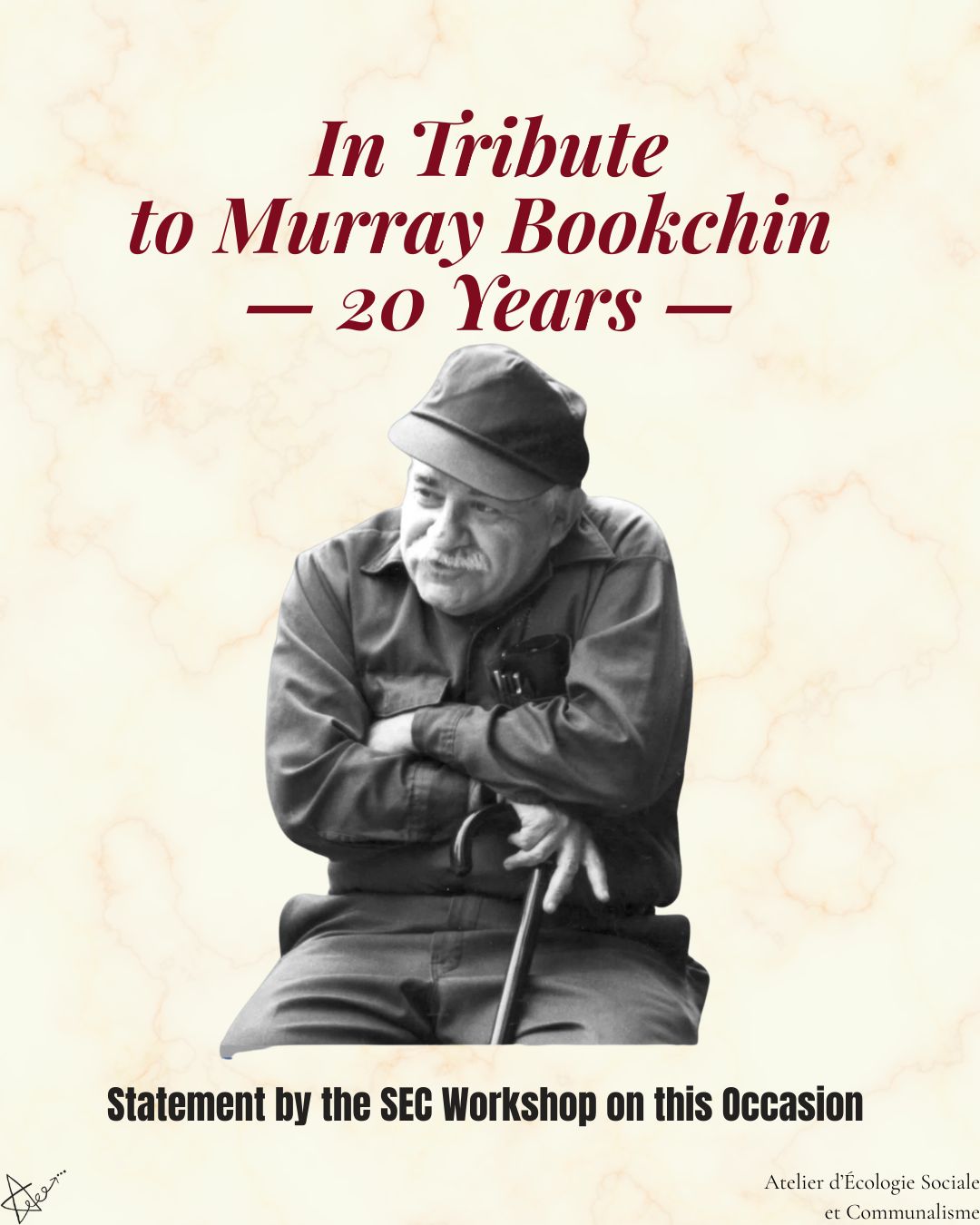

Statement by the SEC Workshop on the Occasion of the International Tribute to Murray Bookchin
Friends, companions,
We speak tonight on behalf of the « Atelier d’Écologie Sociale et Communalisme », a French-language editorial collective formed recently, but steadfast in its determination: to keep alive, in French, the thought that Murray Bookchin spent his entire life building, and which we, twenty years after his death, are in turn striving to carry forward without freezing it in time. While the bulk of our website is in French, it also reaches out internationally, with numerous translations into English, Spanish, and German—and one of our editorial team members, Marc, is also part of the German collective that organized this gathering in tribute to Murray Bookchin. It is largely thanks to this connection that we are speaking here tonight.
We say this straightaway, with the same frankness he himself practiced: we are not Bookchinists. We do not recite a doctrine, we do not defend an orthodoxy, and we are wary of anything that might resemble a cult. But we are grateful for the conceptual work he carried out throughout his life. Keeping this work alive is an honor for us—one that, as the world grows darker, has become a duty of resistance: to prepare together, here and now, for an emancipatory movement, so that another future may be possible.
What We Owe Him
What Bookchin has bequeathed to us is not a closed system, but a method and a demand. The Dialectical naturalism that refuses to separate human history from the history of nature, without dissolving one into the other. A decisive distinction between politics—the state-run, top-down management of human affairs—and the political—collective, self-organized deliberation, which is the very substance of freedom. A libertarian municipalism and a communalist project that pose a fundamental question: how can we stop being governed?
He fought on two fronts at once: against the authoritarian and statist tendencies of bureaucratic Marxism, and against the mystical and irrationalist excesses of a segment of the environmentalist movement. We know, from our own practices, how difficult it is to walk this knife-edge—to remain radical without dogmatism, rigorous without sectarianism.
What We Do Not Owe Him
But we do not owe him a rigid loyalty. Bookchin’s thought itself never stood still; it kept evolving. We believe we are more faithful to him by continuing this movement than by reifying it.
The world of 2026 is not that of the 1970s or 1990s. The deadly acceleration of the dominant system, the climate catastrophe, now a lived reality, the resurgence of the far right, the growing state control even at the municipal level, the emergence of a technological oligarchy that dreams of governing above the states—none of this existed when Bookchin was writing.
To update his thought—and perhaps radicalize it further—is not to betray it: it is to continue the work that he always refused to consider complete.
A Lesson from His Discouragement
We must also acknowledge that Bookchin, toward the end of his life, experienced discouragement. He saw the institutional left make itself an accomplice of capitalism, and a segment of the anarchist movement reduce politics to a sensibility, an individual stance—rejecting any lasting institutional structure, even if confederal and democratic, in the name of a distrust of organization. His ideas were deemed too harsh, out of step with an era that preferred soft consensus to clarifying confrontations. He felt, he said, as if he were on a peninsula slowly being submerged by water.
We know this feeling. In France and in Europe today, it is neither social ecology nor communalism that is finding an audience, but rather a non-libertarian form of municipalism that has been tamed by the institutions. Our radicalism is too often dismissed as a distant utopia, or as pure theory—when it isn’t simply inconceivable to minds shaped by the dominant system. Our audience remains limited, our forces modest. We say this without bombast: we are far from setting a communalist movement in motion.
Nevertheless, Bookchin, even in his darkest moments, never resigned himself to barbarism as the only horizon. And a few years after his death, something has come to pass: in Rojava, a utopia that owes him a great deal has taken shape—with its difficulties and struggles—but one that is truly being lived out by women and men taking up arms against erasure. It is not proof that everything will turn out all right—but it is proof that the “germinal forms” he spoke of are not mere figures of speech.
What remains for us to do
Tonight, we borrow—with a slight modification—a phrase from Pierre Bance: “Another future is still possible, but it must be prepared for”. We added the word “still” because we sense that the possibilities are narrowing. It is no longer a matter of imagining a desirable future in the abstract: it is a matter of preserving, in the time that remains, the possibility of a future grounded in human dignity. And Bookchin understood this before many others: it cannot be waited for; it must be prepared for—in territories, assemblies, confederations, and the forms of direct democracy that we patiently build, with no guarantee of victory.
There is an image we love here at the Atelier—one that has become a symbol of our collective: that of the adventitious plant, the one we call a “weed” because it grows where we don’t expect it—in the cracks of the asphalt and the gaps the system leaves unoccupied, whether through negligence or weakness. Bookchin, would, it seems to us, have recognized this image. Nothing in his thought belonged to the realm of the monument: everything was germination, tendency, potentiality. Perhaps this is his most intimate lesson—beyond concepts, institutions, and programs: a stubborn trust in that which, in every society, in every person, resists the domestication.
We did not come here tonight to celebrate a statue. We came to say thank you to a man who, until the very end, refused to choose between lucidity and hope—and who taught us that we could and must hold onto both. Thank you, Murray. We carry on.
Organized by The Netzwerk für Kommunalismus — you can find the various links here.