


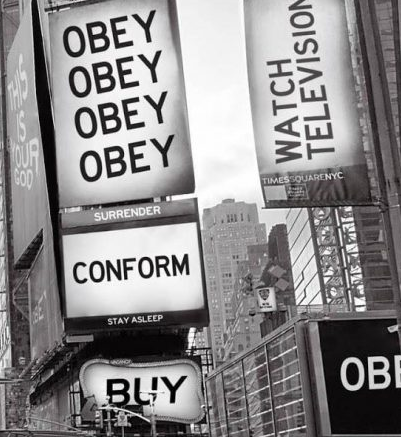

These major sociological and philosophical concepts, indispensable to any understanding of the modes of operation of domination, have, in recent decades, been progressively removed from debate, reduced to silence or plunged into a confusionism largely maintained.
Because you don’t tell a population that you have put under control thanks to a political, economic, media and technological apparatus (the Megamachine) that surrounds it on all sides, that it is objectively and subjectively alienated by this system as a whole, when this alienation is precisely the norm and the goal sought through this environment.
On the other hand, it must be recognized that, as each of us is more or less personally affected in a highly variable manner and at different levels by this alienation, the most common reflex is to ignore it.
It is very unpleasant to admit that our freedom of thought, our very discernment, our ability to make choices, to decide what we really want, are restricted, limited, by a foreign context which, in a way, decides for us. And leaves us with only an illusion of our sacrosanct individual freedom.
For our part, we will therefore place these concepts at the heart of our research for a social ecology, considering them as indispensable as a prerequisite for any real change in the type of society.
Here are some works that will help you rediscover and understand them.
“It is a fact that all totalitarian regimes share a kind of fear of dialectics; neither do they like it when the problem of the unconscious is touched upon too closely. (…) A schizophrenic sleeps in each of us; totalitarians wake him up to put him at their service. This, in our view, is the essence of the general relationship between alienation and the totalitarian spirit. “Technical progress has not opened the door to our prison: it has simply made us change cells.” Joseph Gabel
“What has happened in modernity or what modernity has produced is the ‘breaking of the bond between man and the world’, it is, for man, ‘a loss of the world’. A ‘loss of the world’: this is what seems to me to be the deep and authentic meaning of the concept of alienation.” Franz Fischbach
“Social alienation and mental alienation should not be confused but should not be dissociated. The proof is, he says, that the impact of social alienation can be found in the so-called most desocialized symptoms…
His entire text circumscribes the question of access, or lack of access, to speech. Will an individual be able to speak up in a group?
To sum up, he says that the system of subjectivity in modern states is silencing.“ (Pierre Delion on Félix Guattari’s text ”La transversalité”)
Histoire et conscience de classe (History and Class Consciousness) by Georg Lukács
Of Reification
In the process of critical thought highlighting the alienated and alienating structures of present-day society, “History and Class Consciousness”, published in 1923, is an important stage after Marx and particularly in line with his discoveries in “The Fetish Character of the Commodity and its Secret”, in the development of this thought which makes it possible to envisage another type of social organization.
A society that would allow humans to free themselves from the reification of their being through the domination of market logic. His conceptualization of the phenomenon of reification in this work was undoubtedly a decisive contribution to critical thought in the twentieth century, literally unavoidable for all those who want to understand our time.
It will therefore come as no surprise that Lukacs was forced to recant this book and the main theses he defended in it by the Leninist-Stalinist bureaucracy, representative of the domination in the bureaucratic-statist capitalism that was the so-called “Soviet” Union.
For example, 90 years ago he was already stating:
“We must begin to see clearly that the problem of the fetishism of the commodity is a specific problem of our time and of modern capitalism. (…) The question here is to what extent commodity trafficking and its structural consequences are capable of influencing ALL of society’s life, both external and internal. The question of the extent of commodity trafficking as the dominant form of organic exchange in a society cannot therefore be treated – following modern habits of thought, already reified under the influence of the dominant commodity form – as a simple quantitative question. The difference between a society in which the market form is the dominant form and exerts a decisive influence on all manifestations of life, and a society in which it only makes episodic appearances, is rather a qualitative difference.”
Or again in this reflection, the contemporary significance and gravity of which no one should be able to ignore: “Time is everything, man is nothing; at most he is the carcass of time. Quality is no longer an issue. Only quantity decides everything: hour by hour, day by day. Time thus loses its qualitative, changing, fluid character: it freezes into an exactly delimited, quantitatively measurable continuum, into a space.“
”(…) The personality becomes the powerless spectator of everything that happens to its own existence, an isolated fragment integrated into a foreign system.”
“What is typical of his fate in the structure of the whole society is that in his objectification and becoming a commodity, a function of man manifests with extreme vigor the dehumanized and dehumanizing character of the commodity relation.”
Le Château (The Castle) by Franz Kafka (1926)
“The category of alienation and its corollary, reification, appear to be truly privileged concepts for understanding Kafka’s work.” Gabel
“One of the principles governing the work of the administration is that the possibility of error must never be considered. This principle is justified by the perfection of the organization as a whole and is necessary if we want to achieve maximum speed in the dispatch of business. Sordini therefore had no right to inquire with the other offices; these offices would not have answered him anyway, because they would have immediately realized that it was a matter of looking for a possibility of error.” Kafka
La conscience mystifiée (The Mystified Conscience) followed by La conscience privée (Private Conscience) by Henri Lefèbvre and Norbert Guterman (1933)
This book, published in 1936, had a cursed destiny: it was banned by Soviet “communism” and burned by the Nazis.
The two authors analyze the public aspect of social consciousness and dismantle the mechanisms that allow dominant powers to impose representations of reality that are the opposite of reality on individuals. In this way, they are able to expand on Marx’s theory of alienation.
For them, “fetishism, alienation, mystification are three almost equivalent terms, three aspects of a single fact”.
George Orwell’s 1984 (1949)
Recommended translation: Nineteen Eighty-Four Celia Izoard, published by Agone.
The links between Orwell’s work and the themes on this list will certainly be clear to everyone.
“The idea came to him that the true characteristic of modern life was not its cruelty or its insecurity, but simply its naked, dull, submissive aspect.”
This is what many do not want to hear because of what it says about their own existence and will therefore prefer to dismiss it on the pretext of a fictional flaw. The world of 1984, which is also our world in many respects, is characterized by this common reaction: “That’s true, but I’d rather continue to ignore it.”
Perhaps that is why everything continues as it is…
La Réification (The Reification) by Joseph Gabel (1951)
In a capitalist economic system, reification refers to the process of excessive rationalization that tends to petrify the functioning of society as a whole. The man of the reified universe belongs to a dehumanized world, which tends to reduce the qualitative aspect of life to a thing composed of quantifiable elements. Reified consciousness thus resembles, in many respects, that of the patient suffering from schizophrenia, insofar as it establishes a relationship of radical strangeness to the idea of movement, and more broadly to that of History. The various summaries of observations of schizophrenics that Joseph Gabel attaches to his essay are edifying. Unable to consider the multiplicity of facets of an object or showing complete detachment from moral questions, the schizophrenic appears as an individual suffering from symptoms similar to those that the process of reification extends to the whole of modern society.
“In the case of the patient B…, it is the moral aspect of reified existence that dominates the scene. (…) For him, beings have value only in terms of the services they are likely to render him. This is exactly what, nowadays, we have come to call “objective morality”; it is also that of the child who has not yet passed the stage of egocentrism.”
Minima moralia by Theodor W. Adorno (1951)
Adorno undertakes, through short chapters, vignettes, snapshots, a vast critique of modern society, chasing, to the innermost depths of individual existence, the objective powers that determine and oppress it. This book, which should be studied as a sum, should be welcomed as an art of writing, meditated upon as an art of thinking and practiced as an art of living. Better still: an art of resistance.
“Considering the object rather than the communication at the moment of expressing oneself arouses suspicion (…). Rigorous expression imposes an unequivocal understanding, a conceptual effort that men have deliberately lost the habit of. (…) Only what they do not have to understand seems comprehensible to them.
The prospect of potential benefits is a fatal obstacle to the establishment of genuine relationships worthy of man: such relationships may bring us mutual aid and solidarity, but they can never arise from utilitarian ulterior motives.
For the delicacy between beings is nothing other than the awareness that relationships free from utilitarian ends are possible.
The absurdity perpetuates itself: domination is transmitted through the dominated.
L’obsolescence de l’homme (The obsolescence of man) by Günther Anders (1956)
“It is not enough to change the world. We change it anyway. It even changes considerably without our intervention. We must also interpret this change in order to be able to change it in turn. So that the world does not continue to change without us. And so that we do not end up in a world without men.”
The task of those who present the image of the world to us is thus to construct a false Whole for us from multiple partial truths.
Any doctrine that calls the system into question must first be designated as subversive and terrorist, and those who support it must then be treated as such.
The ambiguity inherent in radio and television programs consists in the fact that they immediately and by principle place their audience in a situation where the difference between experiencing an event and being informed about it is erased.
Only by permanently accustoming the consumer to this state of indecision and oscillation, that is to say by making him a man incapable of making the slightest decision, can one be sure of having him as a man. It is to this end and to take advantage of its moral consequences that one maintains in him the inability to distinguish between being and appearance. “
La Fausse conscience (False consciousness) by Joseph Gabel (1962) reissued in 2023
Opinions on all political subjects are increasingly polarized today. Whether they are described as ‘progressive’ or ‘reactionary’, those who express these opinions do so in the same way: by targeting a category of individuals as the source of all evil, by putting phenomena that have nothing to do with each other on the same level, and by rewriting the past. Blind to the facts that contradict their convictions, militant minds consider any contradiction to be unacceptable, even dangerous.
At the root of this type of attitude is what Joseph Gabel called false consciousness, or the alteration of vital contact with reality. It is the foundation of ideologies, the application of abstract and rigid systems, closed to experience, apprehending human beings as objects. Nazism and Stalinism were the most extreme examples of this.
But as Gabel suggests, it is in fact the capitalist and technocratic organization of our society that favors the development of false consciousness: the preponderance of having over being, of quantity over quality, as well as depersonalization and reification, abolish any human dimension.
Critique de la vie quotidienne (Critique of Everyday Life), volume 2 by Henri Lefebvre
Foundations of a Sociology of Everyday Life
See review of this work on this site. https://ecologiesocialeetcommunalisme.org/2022/06/18/critique-de-la-vie-quotidienne-tome-2-de-henri-lefebvre/
La Dialectique du concret (The Dialectic of the Concrete) by Karel Kosik (1963)
“Capitalism is a system of reification or total alienation, a dynamic system that swells cyclically and reproduces itself in the midst of catastrophes, with men appearing under the characteristic mask of civil servants or agents of this machine, that is to say as its constituent parts or elements.”
This very important work, published in Czechoslovakia in 1963, released in France in 1970 and having earned its author censure and marginalization by the Stalinist regime of the time, has become almost impossible to find today in France. It is our intention to publish large extracts from it on this very site.
Écrits sur l’aliénation et la liberté (Writings on alienation and freedom) by Frantz Fanon
Frantz Fanon was a psychiatrist and anti-colonial activist who died prematurely in 1961 at the age of thirty-six. He was the author of ‘Black Skin, White Masks’, 1952, among other works.
This book brings together a collection of little-known texts published in 2015.
Dialectique négative (Negative Dialectics) by Theodor W. Adorno (1966)
“It would be a fiction to suppose that, in social conditions, particularly of education, which in many ways bridle, arrange, and cripple the spiritual productive forces, that with the poverty that reigns in the realm of the imagination and the pathogenic processes of early childhood diagnosed by psychoanalysis but nevertheless in no way modified in reality, all could understand everything or at least realize everything.”
“Yet the constant hostility to the mind constitutes more than a simple trait of a subjective bourgeois anthropology. This hostility stems from the fact that the concept of reason once emancipated must, in the context of the present conditions of production, fear that its consequence will blow them up.”
La Société du Spectacle (The Society of the Spectacle) by Guy Debord (1967)
“The Society of the Spectacle”, 57 years after its publication, remains one of the major contributions to the understanding of contemporary society. It is the very truth of its theses that makes this work incomprehensible to the greatest number of people, bringing with it a confirmation over time that the author would certainly have preferred to do without.
The Society of the Spectacle is not a book for “intellectuals”, nor a collection of theoretical abstractions, but a book deeply connected to our reality, to our history. The difficulty lies in the act of thought of reclaiming a reality that has escaped us. See the review of the book on this site.
Sociologie de l’aliénation (Sociology of alienation) by Joseph Gabel (1970)
“Let us simply note that excessive identification (or illegitimate identification) seems to constitute a fundamental logical structure of the various aspects of alienation. And this fundamental structure is a reified, a-dialectical structure.”
“I am the end or the beginning.” Was Kafka an end or a beginning? We don’t know, and that may be the key problem for the future of civilization. So far, only the negative aspect of his work seems valid. Reification is present in our daily lives, but no one has shown us the way to the Oklahoma circus yet. The negativity of the era is the failure of humanity.
L’Homme sans monde (The Man Without a World) by Günther Anders
“Almost all my concerns – speculative, political, educational and literary (…)- were focused on the ‘man without a world’, by which I mean those who are forced to live in a world that is not their own, a world which, although they produce it and keep it going through their daily work, is not ‘built for them’ (…), is not there for them, a world for which they are thought of, used and “there”, but whose standards, objectives, language and taste are not theirs, have not been given to them. “
L’Aliénation (The Alienation) by Jean Oury (1992)
The word “alienation”, of Latin origin, appears in several fields: legal, metaphysical, aesthetic, religious. But we rely above all on Germanic expressions, those taken up by Hegel, then Marx. The study of the processes and social contexts that are at stake in this kind of “semiotic” is all the more important as the analysis of social alienation is the very basis of any “institutional analysis”.
L’aliénation : Vie sociale et expérience de la dépossession (Alienation: Social Life and the Experience of Dispossession) by Stéphane Haber (2007)
Developed by Marx for his first analysis of capitalism, for a long time at the center of critical philosophies and sociologies inspired by Marxism, the theme of alienation fell abruptly into disfavor a few decades ago. It was then suspected of being linked to a whole series of outdated images and ideas: a corrupt human nature that would have to be restored beyond the errors of history, a subjectivity that, normally master of its objects, would sometimes get lost in its own products, or a modern society that has become totally “alien” to individuals unrestrictedly subjected to the mechanisms of subjugation. This work first offers a critical review of the contrasting history of the issue of alienation since Marx. But it aims above all to rehabilitate and reconstruct this issue in a non-essentialist way, according to a psycho-sociological and existential inspiration. For alongside similar critical categories capable of commanding paradigms in social theory (“exploitation”, “domination”, “oppression”, “exclusion” …), that of “alienation” deserves to regain a place of choice in the field of philosophical and sociological reflection. Understood correctly, it is the only way to directly conceive of the essence of a life that passes by itself and experiences this loss in suffering and self-limitation. From this point of view, alienation appears as the concrete experience of a dispossession of our individual power to act, which reflects and expresses in its own way, and in variable modes, some of the different pathologies affecting society.
Sans objet – Capitalisme, subjectivité, aliénation (Devoid of Object – Capitalism, Subjectivity, Alienation) by Franck Fischbach (2009)
The modern fact is first and foremost that we no longer believe in this world, in the world of here below, in the world of immanence. What has occurred in modernity or what modernity has produced is the “rupture of the link between man and the world”, it is, for man, “a loss of the world”. A “loss of the world”: this is what seems to me to be the deep and authentic meaning of the concept of alienation.
If the social body is so docile and submissive, it is because it has been deprived of any means of exercising control and deploying its own power. And this dispossession of the conditions for the exercise of its own power is the very effect of the mechanisms as they produce subjectivity: insofar as they generate processes of subjectivation, the mechanisms produce beings who are subjects not only insofar as they are subjugated, but primarily insofar as they are abstract subjectivities, separated, cut off from the places, environments, means and conditions without which they can no longer deploy any power to act on their own, nor exercise any active control over their own lives.
What does today’s employee discover, constantly challenged as a free subject and called upon at all times to show himself to be the autonomous subject that he has to be, as the subject supposedly capable of defining his objectives by himself and conducting his projects by himself? They discover, most often through failure, pain and suffering, that they do not have the means that would enable them to assert their autonomy, to see their projects through to completion and to achieve the objectives they have set themselves […]. Access to the objective conditions and means that would enable them [to act as free and autonomous subjects] is systematically taken away and denied to them.
Aliénation et accélération (Alienation and Acceleration) by Hartmut Rosa (2010)
“This strange and completely new form of alienation from our own actions also results, in my opinion, from the self-propelled logic of competition and acceleration.”
A very specific example of this form of alienation is reading books. A serious author spends years reflecting on, preparing and then writing a book that is the fruit of a long experience of reflection. On the other hand, we find a large number of contemporary readers who claim to grasp the work by skipping many passages, with relaxed attention and a refusal of difficulty, some of them filling their gaps with a self-satisfaction of principle and easily persuaded that everything they do not understand therefore has no meaning. The same people will then, without shame, pass definitive judgment on a work that, by force, remains completely foreign to them.
La Liberté dans le coma (Freedom in the com) by Groupe Marcuse (2013)
“At the beginning of the 21st century, the individual finds himself under siege, probably as never before, by the State and big business, suffocated by conformism and in the practical impossibility of living differently from the majority, even if he had the strength or the chance to formulate the desire to do so. It is as if the legal, ideological and anthropological foundations of modernity were literally crushed by the economic and technological developments they have authorized, and by a bureaucratization of social life constantly fed by commercial and technical logic.”
“The modern idea of freedom was formed against the foil of the closed worlds of yesteryear, of village life or in small neighborhoods, with their gossip and their local social control. Economic independence and direct contact with nature have been sacrificed to this desire for anonymity. Now, at the dawn of the 21st century, anonymity – which has taken over many rural areas – no longer offers any protection. Freedom is not achieved by fleeing our humanity but by developing it in a different way.