




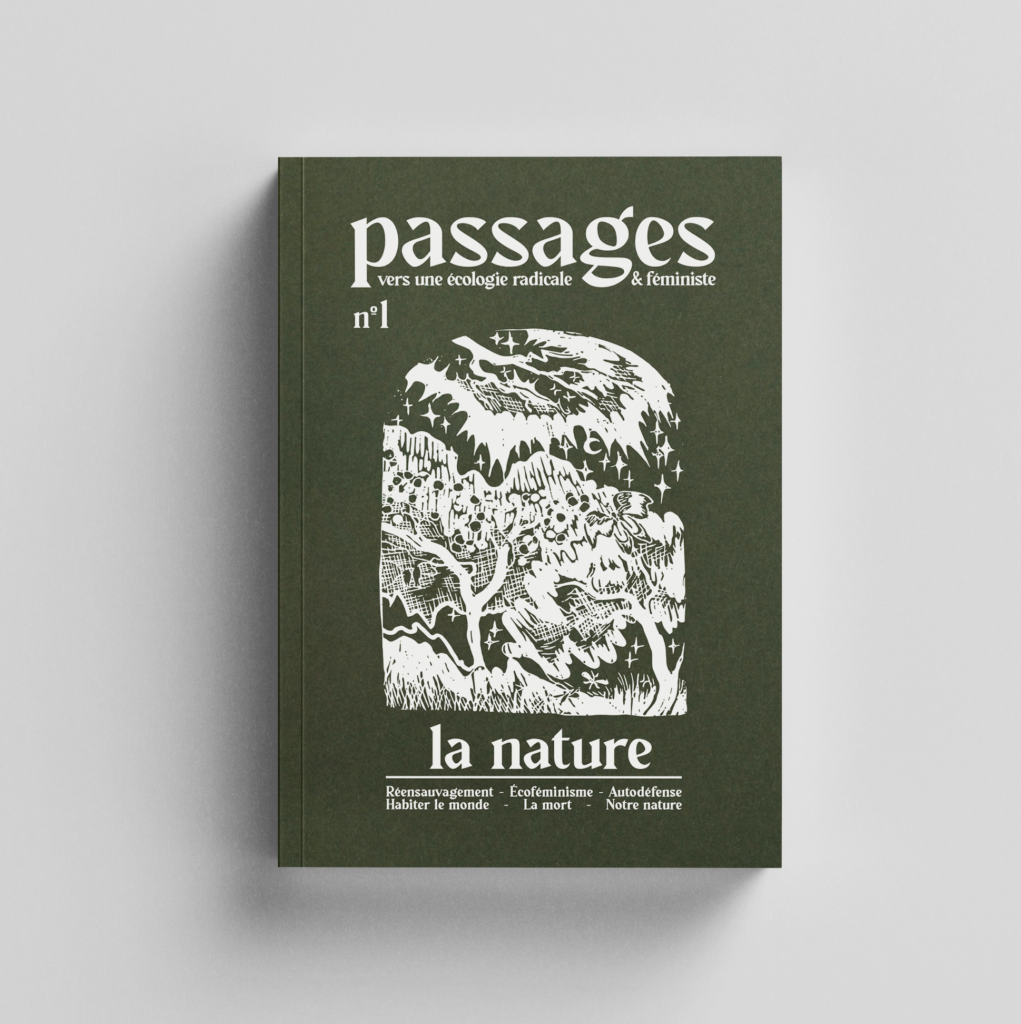

Toward a Radical and Feminist Ecology
While issue zero of Passages laid the groundwork for a critique of civilization as a system of domination, this issue deepens that critique by making nature its central focus—not as a backdrop or resource, but as a philosophical, political, and existential question. The result is an issue that is denser, more heterogeneous, at times more ambiguous, but also, in places, more powerful than its predecessor. It calls for a careful reading that acknowledges its genuine contributions while maintaining the lines of demarcation that a communalist social ecology cannot abandon.
What Passages No. 1 achieves—and what we share
The opening essay, “Our Nature,” charts a third path between two symmetrical temptations—dissolving nature into culture or reifying it as an object of technocratic management. The journal formulates its central definition unambiguously: nature is “what human beings have not created”—and it is also “what civilization exploits, tears away, and inexorably destroys […] that which, whether living or dead, animate or inert, contains an intrinsic and immeasurable value.” Social Ecology fully shares this rejection of constructivism and technocratic reductionism—we will return later to what dialectical naturalism adds to and corrects in this regard. What can be stated from the outset is that, for Bookchin as well as for Passages, the ecological crisis is above all a crisis of social organization and of the hierarchical relationships that structure it—and not a natural destiny or an inevitability for the human species.
The article “Inhabiting the World: Environmental Ethics in the Face of Disaster,” drawing on Baird Callicott, Nastassja Martin, and anthropological studies of the Lakota, Ojibwa, Tukano, and Gwich’in peoples, demonstrates how non-naturalist cosmologies have, for millennia, enabled ways of life in reciprocity with ecosystems. The conclusion is accurate: it is not human beings in general who destroy nature, but rather a specific ontology—Western naturalist ontology—driven by a particular social organization. The destruction of life is never a natural fate within this framework, but always the product of the hierarchical relationships that structure it.
The lengthy article on Polynesia is one of the issue’s strongest pieces. Following Zohl Dé Ishtar, it demonstrates how colonization operated simultaneously: land expropriation, the destruction of cosmologies, institutionalized prostitution, and nuclear testing. The systemic coherence of the devastation is striking—it is not a series of separate abuses, but a program, the logic of which the journal summarizes as follows: “Nature does not exist when a hegemonic culture grants itself the right to be the sole narrator of the world.” This is exactly what social ecology refers to as hierarchy—a logic of domination that simultaneously permeates relationships with nature, women, and colonized peoples, and which can only be combated as a totality.
The strategic section on ecocentrism—the recognition of an intrinsic value in the entire biotic community—represents a genuine philosophical shift from Issue No. 0. It aligns with Bookchin’s emphasis on the intrinsic value of “first nature”—with one crucial nuance: for Bookchin, humanity is, at this stage of evolution, the most developed form of reflexive consciousness, though this does not constitute a privilege or a mandate for domination—nature, which, through human beings, becomes conscious of itself, to borrow the phrase of Élisée Reclus that is so dear to us. This capacity for reflection confers upon humanity a special responsibility: second nature—human social organization—can betray first nature by dominating it, or remain faithful to it by refusing to destroy it. Strict ecocentrism, if not linked to a theory of social organization, risks erasing this conscious responsibility that makes the self-institution of the political possible: the capacity of communities to establish their own forms of communal life, without delegating sovereignty or resorting to representation.
Limits and Divergences: Where Social Ecology Takes a Different Path
1. A Dialectic That Remains Incomplete
Passages forcefully defends the idea that nature has an existence of its own, irreducible to the human. This position deserves praise for its rejection of constructivism. It nevertheless calls for a crucial clarification that Bookchin articulates right at the beginning of The Philosophy of Social Ecology1: defining nature as “what human beings have not created” risks perpetuating the nature/humanity dualism that dialectical naturalism seeks to dismantle. Nature is not what lies “before” or “outside” of humanity—it is the evolutionary process of which humanity itself is a part, and of which “second nature” is a fully-fledged aspect.
Passages remains, in places, caught up in a static conception of this relationship, coming close to the pitfall of portraying humanity as a pure threat to a nature presented as pure, wounded otherness. The problem is not humanity—it is a dominant minority imposing a specific social form, whose hierarchical and market-driven logic perverts our relationship with the living world. But we must go further: this social form cannot be reduced to the will of an identifiable ruling class. The critique of value invites us to recognize that capitalism also functions as an automaton—an endless dynamic of valorization that imposes itself on everyone as a structural constraint. The categories that organize our relationship to the world—value, commodities, abstract labor, the separation between the public sphere and the reproductive sphere—are not merely instruments serving a single class: they constitute the social form itself.
This dual perspective shows that emancipation requires both the removal of those who exercise power, the abolition of the social forms that make this power possible and necessary, the reconstruction of a non-destructive relationship with primal nature—and work on our own psyche: to de-internalize the categories of capital that we have assimilated so deeply that they appear natural to us, in order to reopen the space for desires and imaginations that are not shaped by market logic. The struggle for nature and the struggle for a non-hierarchical social organization are thus, dialectically, one and the same movement—striving toward what might be called third nature: this as-yet-unrealized alloy of first and second nature which, as Marin Schaffner writes in his preface to La liberté dans la nature2, can only be achieved through an “ethics of complementarity”—neither the domination nor the dissolution of the human in nature, but their articulation within emancipatory social and political forms yet to be constructed. It is this profound unity that Passages has not yet fully grasped—in the sense of taking hold of it—and which determines the coherence of any emancipatory project capable of rising to the challenge of the disaster. The journal itself senses this necessity when it states that “we can only conceive of an ambitious strategy within an ecocentric framework”—but without yet articulating this framework with the concrete, self-organized forms of a non-hierarchical, non-market-based social organization that corresponds to it.3
2. Rewilding: A Legitimate Aspiration, a Utopia Without a Foundation
The interview on rewilding is one of the most vivid passages in the issue. Reconnecting with the body, with natural rhythms, and with collective life on the margins is an understandable aspiration—and the idea that resistance needs a desirable perspective is correct. But rewilding can serve as such a perspective only for a tiny minority: the ecological, spatial, and cultural foundation that would make it possible for everyone has been irrevocably destroyed by industrial civilization itself. This experience, whether individual or in small groups, leaves unanswered the question of those who live in cities and still depend—for a not insignificant period of time—on the infrastructure of industrial civilization for their subsistence. The planet simply can no longer feed all of humanity according to hunter-gatherer ways of life: this is not a vision for the future; it is an ecological and material impasse that the journal does not sufficiently acknowledge. Communalism poses the question differently: how can we transform social relations from within the communes to create non-hierarchical and ecologically sound living conditions—for everyone, not just a few? “Rewilding” illustrates what we observe across an entire critical tradition: a clear-eyed understanding of what must be rejected, yet lacking an institutional framework to elevate this rejection to the societal level.
3. Ecofeminism: A Framework Still Under Construction
The text “Dominating Nature, Dominating Women” powerfully expands upon the article on Gilgamesh from Issue 0. The parallel between extractivism and pornography, between the colonial gaze and the pornographic gaze, between the domestication of nature and the domestication of female bodies, shows that the same logic of domination is at work in seemingly distinct spheres. Mary Zeiss Stange’s contribution, through the figure of the female hunter, reopens the question of the direct relationship with the living—including its deadly dimension—as a condition for genuine emancipation.
What is still missing is the connection to a theory of the social relations of production and reproduction. Federici and Mies have shown how the primitive accumulation of capital was built upon the simultaneous devastation of nature and of women’s reproductive labor. Roswitha Scholz allows us to go further: with the theory of value-dissociation, the feminine—and with it everything pertaining to care, reproduction, and the immediate relationship to nature—is dissociated from the sphere of value not by accident, but because the value-form can function only by expelling from itself that which it cannot absorb without negating itself. The domination of women and the destruction of nature are not two parallel struggles—not because women are nature, an association that Passages rightly denounces as a patriarchal instrument of double domination, but because they are co-constituted by the same blind mechanism of capital: that which the value-form cannot absorb without negating itself—care, reproduction, the immediate relationship to the living—is rendered alien to it and designated as an exploitable “outside.” It is this structural co-constitution, and not an ontological identity, that communalist social ecology seeks to theorize.
What Passages No. 1 opens up—and what we expect from No. 2
Passages No. 1 is a more substantial and better-articulated issue than its predecessor. The distinction between ecocentrism and anthropocentrism, the critique of “the sanctuary model” as the flip side of extractivism, the analysis of Indigenous cosmologies, and the intersection between radical feminism and the defense of life: all these elements make this journal a serious interlocutor for anyone thinking about ecology beyond reformist paths.
What remains unresolved—and what Issue No. 2, devoted to feminism, could help resolve—is the question of the co-constitution of forms of domination. Passages has shown that the destruction of nature and the domination of women stem from the same hierarchical logic; it still needs to theorize this unity—to argue not only that they coexist, but that they are structurally produced by the same social form. This is where the dialogue between Passages and communalist social ecology has the most to gain—and the most to offer to those who seek, beyond resistance, the forms of an alternative world.
1Murray Bookchin, The Philosophy of Social Ecology. Essays on Dialectical Naturalism, third edition (first ed. 1990; second ed. 1996), AK Press, 2022. Afterword by Todd McGowan.
2Marin Schaffner, preface to Murray Bookchin, La liberté dans la nature, Wildproject, 2026.
3This lack of an instituting perspective is likely not merely a theoretical blind spot. It undoubtedly stems from a deeper inhibition—found in most contemporary radical currents—linked to the confusion between politics and the Political (in the philosophical sense of collective self-institution): the former refers to parties, elections, political economy, and the representative and authoritarian state—all of which the disasters of the 20th century have turned into legitimate targets of criticism; the latter denotes the capacity of communities to institute themselves and to deliberate collectively on their shared life, outside and against any delegation of sovereignty. This taboo surrounding “politics,” which has become a taboo surrounding “the Political,” thus affects non-state instituting forms just as much as those it purports to reject. It is precisely this distinction—and its fruitfulness for any emancipatory project—that communalist social ecology seeks to question and reestablish.
Further Reading: