


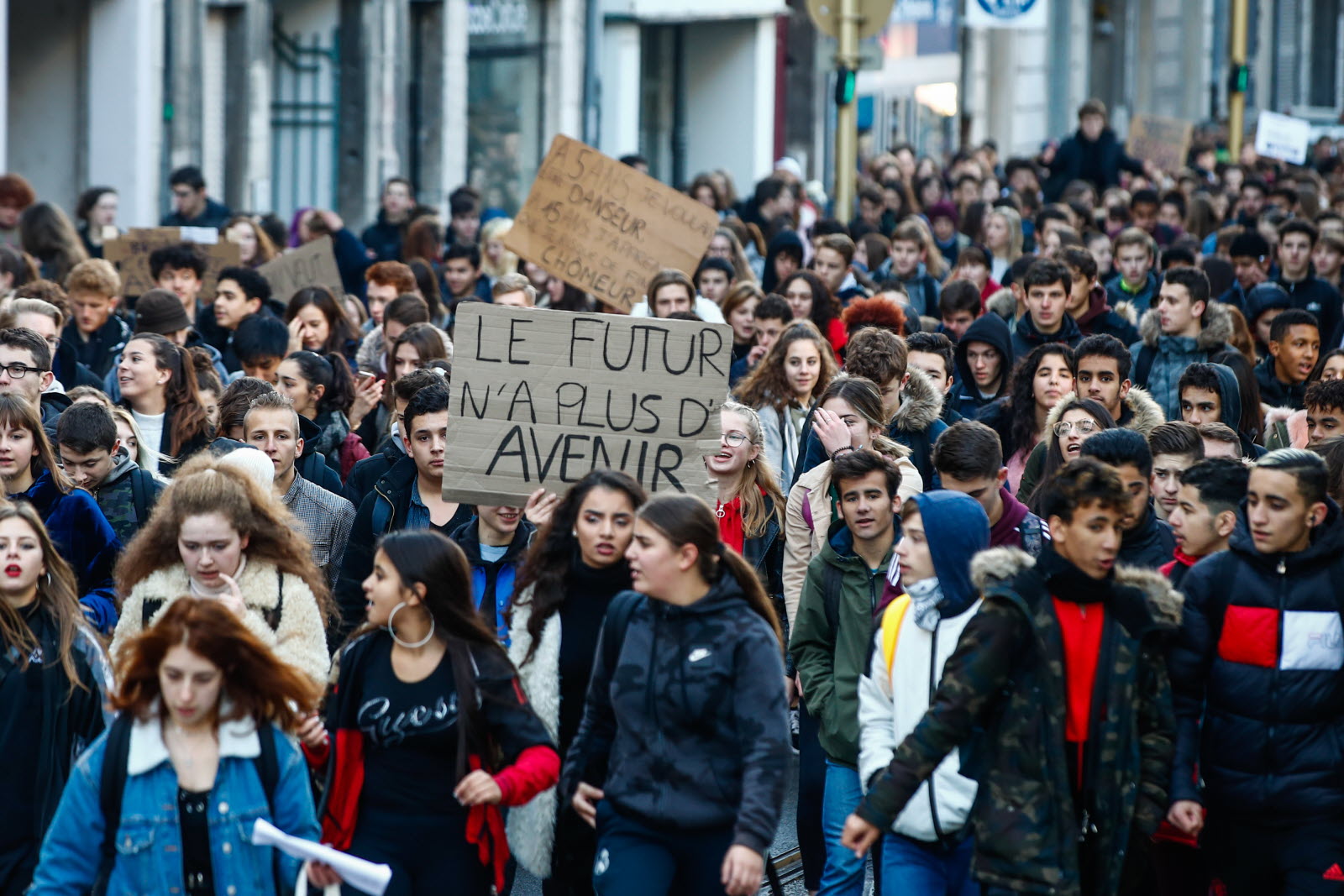

High school students are demanding teachers, desks, and decent school buildings. The police are sent against them. Let’s support them, in concrete ways, starting now. But let’s also give them back what has been stolen from them in the first place: their future. What might learning to live in a society free from capital and the state look like?
Don’t Lock Youth Away in Their Cage
Since mid-September, hundreds of high schools have been blockaded. It started with something obvious: in Créteil, classes had no teachers. The state responded with tear gas, rubber bullets, and police custody. In Tours, a sixteen-year-old boy lost the use of one eye. In Val-d’Oise, a fourteen-year-old teenager had his jaw broken. In Lens, a fifteen-year-old high school student had his hand torn off by a police grenade. Elsewhere, police cars plowed into groups of high school students1.
We have denounced this violence2. But perhaps the worst thing this society inflicts on its children is not the baton: it is the confiscation of the imagination. They are constantly told that there is no alternative—that “fatalistic consciousness” denounced by Paulo Freire—and that the future boils down to Parcoursup (France’s centralized university-admissions platform), precarity, and the collapses already underway and yet to come. Shattering this supposed inevitability is already, in itself, an act of solidarity.
What the School of Capital Really Teaches
Ivan Illich spoke of the “hidden curriculum”: there, students learn less about mathematics than about obedience, submission to evaluation, and the idea that knowledge is a commodity that is traded for diplomas. Joseph Jacotot, whom Jacques Rancière made the hero of The Ignorant Schoolmaster, summed it up in a single phrase: “Whoever teaches without emancipating stultifies.” This school system separates everything that a human life should unite.
• The mind and the hand. It sorts some into design and others into execution, and students in vocational tracks know they are looked down upon. But a degree no longer offers protection: the engineer has become an assembly-line designer, and it is work itself that is in crisis at every level, as Robert Kurz has shown.
• The generations. Organized into cohorts, children are cut off from their elders and kept apart from social life. Childhood is an investment; old age is a “burden” (Cornelia Hummel); schools, businesses, and nursing homes no longer intersect. “Adults treat us like idiots,” says a high school student from Val-de-Marne3.
• Knowledge and place. We learn the same things everywhere, without knowing anything about our own river. But the school system operates at different speeds: neglected working-class banlieues on the urban outskirts, rural areas deprived of options and cultural opportunities, and private schools reserved for the elite. It standardizes content to better reproduce class divisions, as Bourdieu and Passeron have shown.
• The student and their peers. Assessments starting in first grade, grades, rankings, Parcoursup: it’s everyone against everyone else, and helping one another is called “cheating.” At sixteen, the student becomes “an entrepreneur responsible for their academic career,” while managerialism ranks schools and teachers and “systematically smashes collectives”4. The game is rigged: school rewards the art of “giving the teacher the right words, at the right time”5, a code that children from working-class backgrounds have not inherited. This war is sold to them as a law of nature; Kropotkin, and later Lynn Margulis, have shown that cooperation is a driving force of life at least as much as competition. A school that teaches the opposite is, by design, teaching nothing but the law of the market.
• Lived time and measured time. Bells, curricula to cover, timed reading starting in elementary school: school is the first school of the clock. In rural areas, children rise before dawn and spend hours on buses. Thus, from a very young age, they are taught to accept deprivation and separation.
Parcoursup completes the task. In 2025, Education Minister Élisabeth Borne even wanted to start career guidance “almost from kindergarten”6: the sorting begins in the sandbox. It’s no surprise that the police stand guard at the gates, when they aren’t invading classrooms and lecture halls: the school-barracks and the barracks produce the same separated, docile, and exploitable individuals. Let us defend the school against those who bleed it dry, but without illusions: we will not make the revolution “without simultaneously abolishing the capital that produces the school and the school that reproduces capital”7.
Imagine: The Educating and Emancipating Commune
Let’s take a step sideways, into an ecological and communalist society that has transcended capital and the state. The communes federate; their assemblies, open to children, decide on their conditions of existence. The school has left its walls to re-embed itself in communal life: this is the Greek paideia, which Bookchin and Castoriadis identified as the condition for any true democracy.
Nothing new under the sun of freedom. As early as 1876, James Guillaume, a comrade of Bakunin in the First International, outlined the program: “No more schools arbitrarily governed by a teacher, where trembling students yearn for freedom and the games outside. In their gatherings, the children will be completely free: they will organize their own games and discussions, establish a committee to direct their work, appoint arbitrators to settle their disputes, and so on. They will also grow accustomed to public life, responsibility, and mutual aid; their teacher—whom they will have freely chosen to instruct them—will no longer be, for them, a hated tyrant, but a friend whom they will listen to with pleasure.”8
A Day in Line’s Life. Line is fifteen years old. This morning, along with some of her peers, she is repairing the watermill’s wheel alongside a woman carpenter and a former miller: the flow rate of the millstream, the gear ratio, the choice of oak over pine. This is Kropotkin’s “integral education.” No one grades her; she’ll know she’s understood when the wheel turns. In the afternoon, the teenagers deliberate at the neighborhood assembly on a water catchment project, after investigating the groundwater table with hydrologists and farmers. In the evening, at the community center, a high school student teaches a retiree how to share her photos of heirloom varieties from the orchard on the peer-to-peer network; she will teach him how to graft apple trees. Knowledge here is not a rent, but a gift that calls for a gift in return. Guillaume, again, refused to entrust education “to a special caste of teachers; anyone who knows a science, an art, or a trade can and must be called upon to teach it”9.
A Season in Line’s Life. Three times a week, Line joins other young people her age for the shared core curriculum: reading, math, science, and history. Every week, the commune gathers in the forest garden, then in the evening for puppet shows, choir, and storytelling: no one “worked” or “played”—we simply lived together. In winter, when the fields lie fallow, Line will head to a coastal commune to study marine biology. At the end of each season, a gathering before the assembly ensures that no one has been left behind.
A few principles stem from this:
• Knowledge as a common good and the equality of unequals. Libraries, laboratories, and tools belong to everyone. Each person learns at their own pace and according to their own abilities. For, as Jacques Rancière reminds us, the equality of intelligences is not an ideal to be achieved “through a good strategy, good leadership, or good science”: it is a starting point, a presupposition to be verified. The ignorant person “already knows something,” and no knowledge grants the right to command10. It is the commune that adapts to bodies and minds, not the other way around: no disability relegated to an institution, no child labeled, no difference turned into a basis for sorting. The commune compensates for inequalities rather than ranking them, and specialized knowledge—such as that of a surgeon or a physicist—remains accessible to as many people as possible.
• Open roots and shared subsistence. We begin by learning about our bioregion, without retreating into narrow identities. Cultivating, cooking, tinkering, building, and repairing: among everyone, women and men alike, without gender or ability-based assignments, each person contributing according to their own capacity. There is no political autonomy without material autonomy.
• All generations together. There is no longer an age limit for learning or teaching. We live in interdependence and care: the elders once again become guides, the young become catalysts for momentum and innovation. Each age group gives the other what it lacks.
• Disposable time. Freed from the race for productivity, the commune has time to deliberate and care for every generation, from the youngest to the oldest. We move forward, say the Zapatistas, at the pace of the slowest. Culture and leisure, “inseparable from education,” are no longer the monopoly of a single class; indeed, as Pierre Bance writes, everyone retains “a right to do nothing”11.
Can an isolated commune pass on too little? The answer is not a ministry, but a confederation: a common foundation defined together—a guaranteed baseline that is never a mold—shared resources, and for every young person the right, and above all the material means, to go learn elsewhere. While the commune may be the place where the youngest children’s minds are awakened, it “will have to partner with others,” notes Pierre Bance, for more advanced knowledge12. Young people would no longer be asked what they want to “do later in life,” but rather what they want to learn now, with whom, and to do what together.
None of this is a magic formula. “When it comes to education—even anarchist and self-managed—we must remain humble,” warns Hugues Lenoir: the results of educational efforts are “always partial, approximate”13. All the more reason for the commune to deliberate on this constantly, together with those who are learning.
This Is Not a Pipe Dream
This educational commune has already existed in fragments: Paul Robin’s Cempuis orphanage, the Modern School of Francisco Ferrer (who was executed in 1909), the Spanish anarchist ateneos14, the school cooperative and printing press of Élise and Célestin Freinet, the Experimental High School of Saint-Nazaire, the autonomous Zapatista schools, and the academies of Rojava. From Makarenko, we retain only the insight that the collective educates, and we reject his military discipline: acting as one is not marching in step. Many of these experiments were crushed by the state or the Church. Yet there were times when the state itself drew upon them: during the Third Republic, Ferdinand Buisson, director of primary education, “called upon two Bakuninist anarchist activists,” Paul Robin and James Guillaume, “for his major educational projects”15. All of them prove that another way of learning is possible.
Starting Now: Support and Prefigure
One rule takes precedence: this is their movement. They have said it themselves: “We will not allow ourselves to be divided or co-opted.” We provide resources and accept that we may be turned down.
1. Open our spaces, lend equipment, and provide supplies.
2. Be there without taking charge, to bear witness and serve as a link to legal support.
3. Organize the defense and contribute to solidarity funds, through the trial and well beyond the movement.
4. Relay their words with their consent, without ever publishing names.
5. Respond to their calls, starting with bringing together the mobilized sectors they are calling for.
And let us prefigure: people’s universities of struggle, intergenerational knowledge-sharing, open assemblies on the kind of school we want, alliances with teachers who reject national assessments and are rebuilding the collective16, “communalist athenaeums” that endure beyond the blockades.
Give the Future Back to Youth
This society has turned the future into a threat. It demands that its children resign themselves to it, and maims them when they refuse. A society that blinds its high school students only to send them back into classrooms without teachers is no longer defending itself: it is devouring itself. Shame on those who govern it this way, and on those who applaud or remain silent.
Already, here and there, high school students are holding assemblies and beginning to coordinate across schools17. On October 10, in Paris, two hundred high school students from 71 schools and 32 cities held the first national high school general assembly. There, they rejected “self-proclaimed representatives,” called for “organizing from the grassroots up, with general assemblies by high school and by city” coordinated at the national level, “without relying solely on the leadership of the inter-union coalition,” and convened a meeting of “elected high school students” for October 1818. In doing so, they are taking the step that Chilean high school students attempted in 200619: entrusting their voice only to elected delegates—and tomorrow, perhaps, mandated and recallable—so that no leader or organization speaks on their behalf. It is this lesson in autonomy that the state seeks to erase with rubber bullets, and that we must help them preserve. They are fifteen years old and refuse to abdicate before they have truly lived. It is up to us to show them that life can be worth more than what they are promised.
Notes :
1 Le Promeneur, “Child Hunt,” October 7, 2026: https://lepromeneur111.blogspot.com/2026/10/chasse-lenfant.html
2 The Agora of the ESC Workshop: https://ecologiesocialeetcommunalisme.org/lagora/topic/en-quoi-le-sort-fait-a-la-jeunesse-revele-t-il-le-stade-ultime-de-la-barbarie-capitaliste/#postid-388
3 Politis, report on high school student protests, October 2026: https://www.politis.fr/articles/2026/10/reportage-mobilisation-lyceenne-jeunesse-debout-pouvoir-sourd-violences-policieres-comme-reponse/
4 Courant Alternatif, “Management in the National Education System and Resistance,” October 8, 2026: https://oclibertaire.lautre.net/spip.php?article4776
5 Nicolas Kaczmarek, quoted by Habba Lekol, Courant Alternatif, October 8, 2026: https://oclibertaire.lautre.net/spip.php?article4777
6 LCP, April 2025; see RMC (April 9, 2025) and Ouest-France.
7 Habba Lekol, op. cit.
8 James Guillaume (1876), quoted by Pierre Besnard, Les Syndicats ouvriers et la révolution sociale (1930), Éditions Le Monde nouveau, 1978, p. 324; reprinted by Pierre Bance, La Grande Fédération, Éditions Noir & Rouge, 2025, “Le droit à l’éducation, à la culture et aux loisirs” [The Right to Education, Culture, and Leisure], pp. 372–377.
9 James Guillaume, quoted by Pierre Besnard, op. cit., p. 321; reprinted by Pierre Bance, op. cit.
10 Jacques Rancière, “Democracies Against Democracy,” interview with Éric Hazan, in Démocratie, dans quel état ?, La Fabrique, 2009, p. 99 (English edition: Democracy in What State?, Columbia University Press, 2011); and Et tant pis pour les gens fatigués. Entretiens [So Much the Worse for Tired People: Interviews], Éditions Amsterdam, 2009, p. 656. Cited by Pierre Bance, op. cit.
11 Pierre Bance, op. cit.
12 Pierre Bance, op. cit.
13 Hugues Lenoir, Pour une école de la liberté par la liberté [For a School of Freedom Through Freedom], Éditions du Monde libertaire, 2021, p. 9; cited by Pierre Bance, op. cit.
14 TerKo, “Les ateneos libertarios”: https://ecologiesocialeetcommunalisme.org/2025/09/15/les-ateneos-libertarios/
15 Nestor Romero, “Macron, Rearmament, Uniforms, Buisson… and Anarchist Educators,” Mediapart blog, January 9, 2024: https://blogs.mediapart.fr/nestor-romero/blog/090124/macron-rearmement-uniforme-buisson-et-les-pedagogues-anarchistes; cited by Pierre Bance, op. cit.
16 Courant Alternatif, op. cit.
17 In Grenoble, on September 30, 2026, some 150 high school students gathered for an “inter-high school general assembly” (Place Gre’net, October 1, 2026: https://www.placegrenet.fr/2026/10/01/apres-trois-jours-de-blocages-les-lyceens-de-lagglomeration-grenobloise-tentent-de-se-coordonner-pour-poursuivre-la-mobilisation/690541). In Besançon, the movement’s next steps are “decided collectively at the general assembly” (macommune.info, October 7, 2026: https://www.macommune.info/colere-lyceenne-les-jeunes-maintiennent-la-pression-et-sorganisent-au-jour-le-jour-a-besancon/).
18 “Call for the First National High School General Assembly,” Indymedia Nantes, October 2026: https://nantes.indymedia.org/posts/169976/appel-de-la-1ere-assemblee-generale-lyceenne-nationale/
19 During the “Penguin Revolution,” the Coordinating Assembly of Secondary School Students (ACES, Asamblea Coordinadora de Estudiantes Secundarios) operated through assemblies and rotating spokespersons, “subject to the possibility of recall,” according to historian Pablo Toro (The Clinic, February 14, 2020: https://www.theclinic.cl/2020/02/14/a-14-anos-de-la-revolucion-pinguina-cuando-los-secundarios-se-subieron-por-el-chorro/).
Further Reading
• Ivan Illich, Deschooling Society (1971)
• Paulo Freire, Pedagogy of the Oppressed (1968)
• Jacques Rancière, The Ignorant Schoolmaster: Five Lessons in Intellectual Emancipation (1987)
• Murray Bookchin, The Ecology of Freedom (1982)
• Peter Kropotkin, Mutual Aid: A Factor of Evolution (1902)
• Nicolas Kaczmarek, Manuel contre la mise en échec scolaire [A Handbook Against Pushing Students into Failure], La Dispute, 2026
• Jérôme Baschet and Laurent Jeanpierre (eds.), Mondes postcapitalistes [Postcapitalist Worlds], La Découverte, 2026
• Hugues Lenoir, Pour une école de la liberté par la liberté [For a School of Freedom Through Freedom], Éditions du Monde libertaire, 2021
• Collective work, James Guillaume. L’émancipation par les savoirs [James Guillaume: Emancipation Through Knowledge], Éditions Noir & Rouge, 2021
• Pierre Bance, La Grande Fédération [The Great Federation], Éditions Noir & Rouge, 2025