




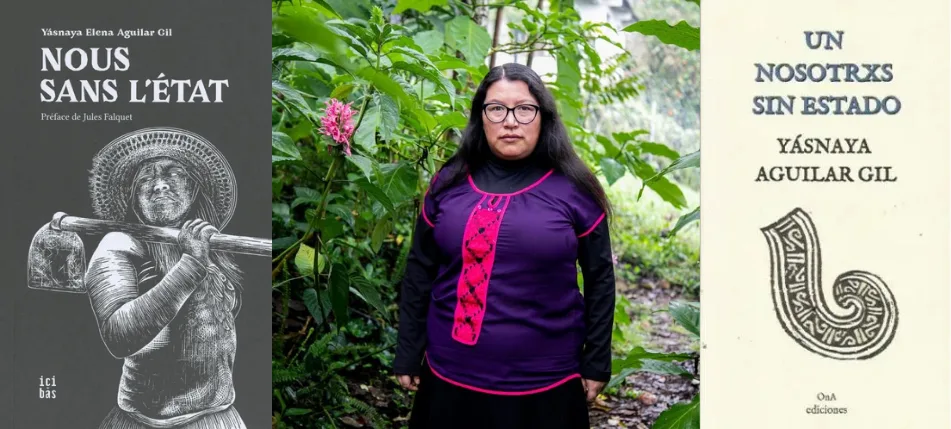

by Yásnaya Elena Aguilar Gil
The book “Nous sans l’État” (Us without the State) by Yásnaya Elena Aguilar Gil, published in 2024 by Ici-bas, is a striking analysis of the forms of indigenous and community resistance to the modern state. Aguilar Gil, a Zapotec author and linguist, explains how indigenous peoples in Mexico and around the world perpetuate and reinvent models of governance that do without the state. This essay highlights the practices of self-management and collective decision-making, and respect for the environmental balance that exists in indigenous communities, as opposed to the extractivist and centralizing logic of so-called “modern” national governments.
Aguilar Gil develops several key ideas: the critique of the nation-state as a hierarchical and colonialist structure, the praise of horizontal and collective forms of governance, and a powerful defense of the territorial and cultural autonomy of peoples. It shows how the modern state, in its colonial and post-colonial form, has systematically sought to destroy or incorporate pre-existing community organizational structures, often in the name of “development” or “modernization”. Yet these communities continue to exist and resist, practicing forms of autonomy based on interdependence, respect for nature, and the values of solidarity and cooperation.
The theories developed by Aguilar Gil in “We the Stateless” strongly resonate with those of social ecology and communalism, which are gradually emerging in the West. These schools of thought, largely inspired by the work of the American ecologist and anarchist Murray Bookchin, focus on the need to redefine modes of social organization that break with capitalism, the centralized state and hierarchies of power. The objective is to build ecologically sustainable and socially just societies, based on the principles of self-management, direct democracy, local autonomy and democratic confederalism at the supra-local level.
Through her analysis of forms of indigenous resistance, Aguilar Gil offers a framework for reflection and concrete examples of alternatives to the state, which could enrich the thinking of social ecology and communalism activists. By emphasizing the importance of horizontal decision-making systems, she reminds us that forms of political self-management exist and work, particularly in contexts of extreme marginalization, where the State is often an agent of oppression rather than protection.
In a European context marked by a crisis of confidence in state institutions and the rise of autonomist and environmentalist movements, “Nous sans l’État” provides key elements for thinking about a transition to local and sustainable modes of governance. In France, the ZADs (Zones à Défendre, or “Areas to Defend”) and in Spain, movements such as those of the libertarian municipality (influenced by Spanish anarchist history) could find in Aguilar Gil’s proposals strategies to articulate their own desire for political and ecological autonomy.
Finally, Aguilar Gil’s emphasis on the symbiotic relationship between communities and their natural environments resonates directly with social ecology, which sees the ecological crisis as a manifestation of the structures of human domination over nature (resulting from the domination of humans over humans, and in particular of men over women, etc.). The rediscovery of indigenous knowledge on resource management and ecosystem preservation could be a major source of inspiration for these movements in France and Spain, where local resource management is becoming a crucial issue in the face of the challenges of climate change.
Yásnaya Elena Aguilar Gil’s essay, which proposes a radical vision deeply rooted in the practice of indigenous communities, is essential reading for anyone interested in decentralization, self-management and radical ecology. His theories provide a new and necessary perspective for the social ecology and communalism movements in Europe, offering concrete examples of the resistance and constant political reinvention necessary to stand up to the state and capitalism.
Translated by TerKo with the help of a free translation tool.
Rebound:
[…] Us without the State #01 […]
[…] Us without the State #01 […]